Guides · Transfer Problems
Transfer Sent but the Beneficiary Didn't Receive the Money? How to Find It and Get It Back
"Sent" and "received" are two different events. Here's how to find out where your international transfer is, who needs to chase it, and what to do if it went to the wrong account.
Quick answer
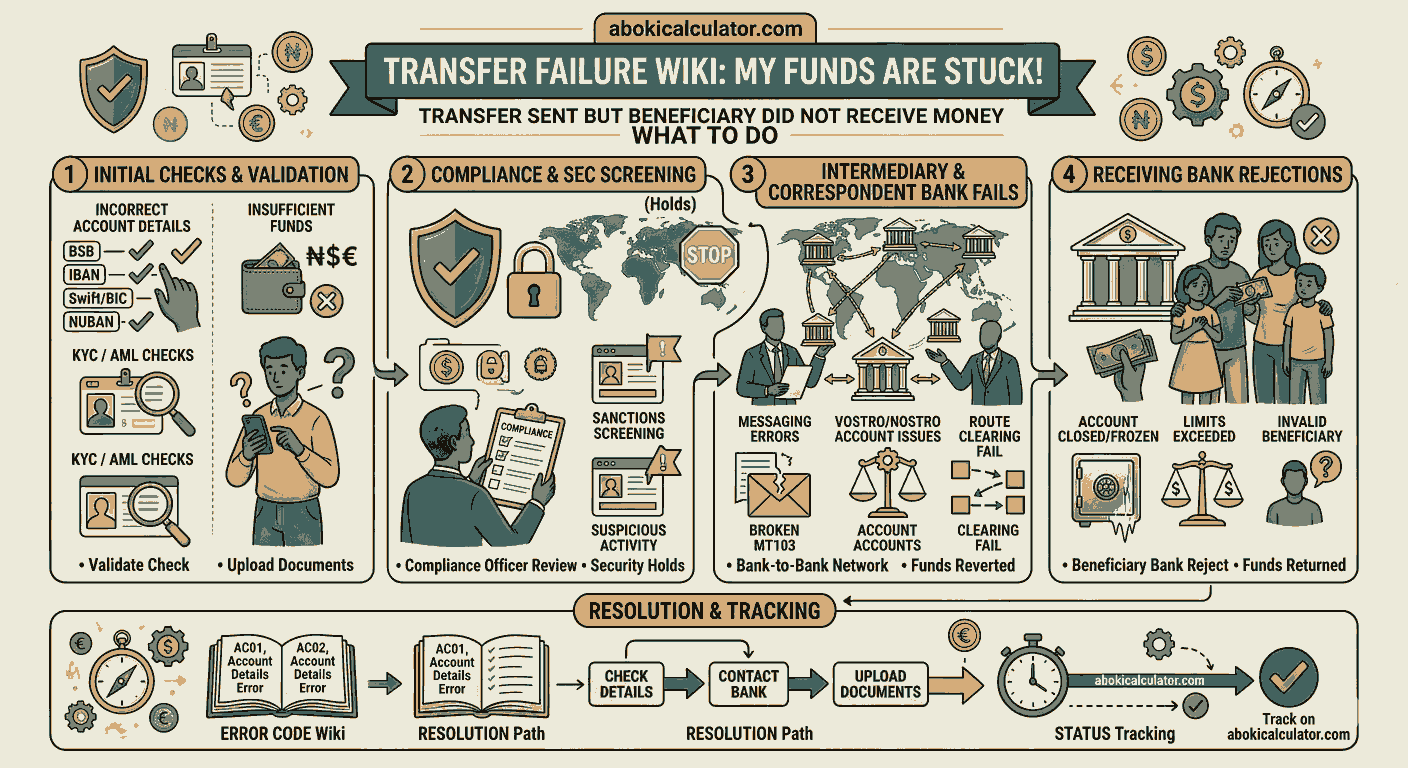
Money leaving your account only means your bank has sent it. It still has to pass through any intermediary banks, reach the recipient's bank, and be credited to the right account. When the recipient sees nothing, the money is usually still on its way, held at the recipient's bank, on its way back to you or, less often, credited to a different account.
What to do: get the payment's UETR (its tracking reference) from your bank and ask for its tracker status. The status tells you whether you or the recipient should chase it. Don't send the money again until you know where the first payment is.
On this page
Which situation are you in?
Ask your bank for the payment's tracker status, then find it here:
| What the bank or tracker says | What it means | Who should act |
|---|---|---|
Still moving (ACSP with G000, G001 or G002) | On its way, or pending at a bank | Wait until the estimated date. If it passes, the sender asks their bank to trace. |
Waiting for funds (G004) | The recipient's bank is waiting for a linked "cover" payment | The sender's bank should confirm and trace the cover payment |
Waiting for documents (G003) | The recipient's bank needs information from the recipient | The recipient contacts their bank |
Credited (ACCC) but not visible | The recipient's bank says it has credited an account | The recipient asks their bank which account was credited, quoting the UETR |
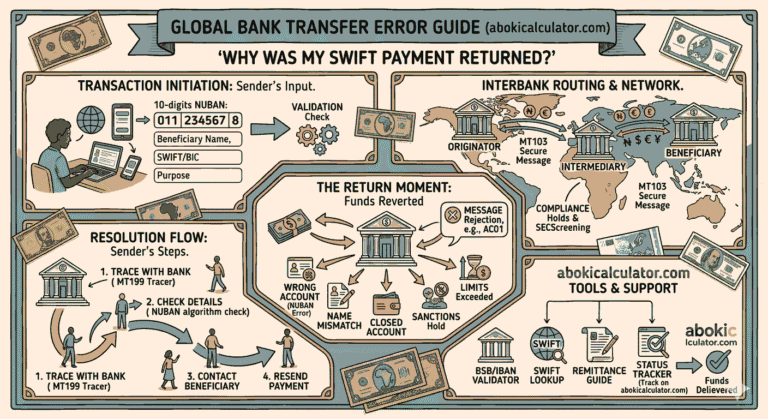
Rejected or returned (RJCT, or a return) | The money is coming back to the sender | The sender gets the reason code. See why SWIFT payments are returned. |
| Under review | A bank is running compliance checks | Whoever the bank asks. See compliance reviews. |
Beware of "completed". Some banks and apps mark a transfer "completed" when they have finished their part, not when the recipient has been credited. Ask specifically whether the recipient's bank has confirmed the credit.
Our SWIFT payment tracker helps you find and check the UETR, explains every status and reason code, and writes a trace request for your bank.
Steps for the sender
- Check the expected delivery date you were given, counting business days in both countries. Before that date, the payment is probably just still moving. See why transfers take long.
- Get the UETR and the exact payment instruction your bank sent: recipient name, account number or IBAN, SWIFT code, amount and currency. Compare every character with what the recipient gave you.
- Ask your bank for the tracker status, and give the UETR to the recipient so they can quote it to their bank.
- If it's late or stuck, ask your bank to open an investigation (trace) with the bank that has the payment. Ask for a case reference.
- If the details were wrong, or you want the money back, ask your bank to request a recall. It can only ask, and once the money has been credited, the receiving bank usually needs the account holder's permission to take it back.
- Don't resend until you know where the first payment is. Otherwise you risk paying twice.
Steps for the recipient
- Ask the sender for the UETR, amount, currency and date, and a copy of the payment confirmation.
- Contact your bank's international payments team, not just the app. Ask whether any incoming payment is pending, held or under review, quoting the UETR. A bank can often see an incoming payment before it appears in your balance.
- Check the details the sender used: your name exactly as your account shows it, your account number, and your bank's SWIFT code. Also check which account and currency they sent to.
- Answer any request from your bank quickly, such as the purpose of the payment or your relationship with the sender.
Give senders the right details
Choose "receive", "international" and your country. The tool lists exactly what to give the sender, including SWIFT/BIC, IBAN or account number and any local code, with links to check them.
Open What Bank Details Do I Need?If it went to the wrong account
This is the case people fear most, and it's worth understanding how it happens:
- A wrong account number that doesn't exist usually can't be credited. The bank holds the money while it investigates, then returns it.
- A wrong account number that does exist can be credited to that account. Many banks rely mainly on the account number, and name checks vary from bank to bank and country to country.
- A wrong SWIFT code can send the payment to the wrong bank, which usually can't find the account and sends it back.
Getting it back: your bank can ask the receiving bank to return the money. Industry guidance recognises that once a bank has credited its customer, it generally needs that customer's permission to take the money back. Recovery is possible, but it isn't guaranteed and can take time. Act as soon as you notice the mistake.
If you think you were scammed
Common scams include a "supplier" or "school" emailing new bank details, a fake invoice, or someone you've only met online asking for money. If you paid the wrong person because you were tricked:
- Call your bank immediately and say you have been the victim of fraud. Ask it to recall the payment and alert the receiving bank. Speed matters most here.
- Report it to the police or your country's fraud or cybercrime reporting service, and keep the reference.
- Keep everything: emails, messages, invoices and the payment confirmation.
Watch out for "recovery" scams. People who promise to recover lost money for an upfront fee are often the same fraudsters, or new ones. Deal only with your bank and the official authorities.
Your rights and how to complain
- United States (remittance transfers): if the money wasn't made available by the date the provider disclosed, or a different amount arrived, you can report an error within 180 days of that date. The provider must investigate within 90 days and, if there was an error, refund you or deliver the money at no extra cost. If you gave the wrong account number, the provider must still try to recover the money, and may avoid a refund only if it meets strict conditions.
- Nigeria: complain to your bank first, in writing, and allow two weeks. If it isn't resolved, you can escalate to the Central Bank of Nigeria's Consumer Protection Department, with evidence of your complaint to the bank.
- Elsewhere: complain to your bank or provider first, then to the financial regulator or ombudsman in your country.
Preventing it next time
- Check the details before you send. Use our IBAN validator, NUBAN validator or SWIFT code checker. A valid format catches typing mistakes, but it doesn't prove the account belongs to your recipient.
- Confirm new or changed details by phone, on a number you already know, never by replying to the email that sent them.
- For a large payment to a new recipient, consider sending a small amount first and checking that it arrives.
- Use the recipient's name exactly as their bank holds it, and add their address and a clear purpose.
- Keep the UETR and confirmation for every international payment.
For Nigerian users
- Receiving from abroad: give senders your name exactly as it appears on your account, your 10-digit account number, your bank's name and its SWIFT code. If the money doesn't appear, ask your bank's international operations team whether an inflow is pending, quoting the UETR.
- Sent through a money transfer company? That's a different route. The payout is made in naira by the operator's partner bank or agent, so contact the money transfer company first. See how international money transfers work.
Transfer within Nigeria debited but not received? This page is about international transfers. A local bank transfer that fails usually reverses automatically. If it doesn't, report it to your bank straight away with the transaction reference and the recipient's account details. Banks handle unresolved electronic payment disputes through an industry dispute resolution system, which the CBN announced in February 2024. If your bank doesn't resolve your complaint within two weeks, escalate to the CBN as described above.
Related questions
My bank says the transfer was sent. Why hasn't the recipient got it?
Sent only means your bank has passed the payment on. It may still be at an intermediary bank, held at the recipient's bank for checks or documents, waiting to be credited, on its way back to you, or credited to a different account. The payment's tracker status, found using its UETR, shows which.
How do I trace an international transfer?
Ask your bank for the payment's UETR, the unique reference that follows a SWIFT payment from bank to bank, and ask for its tracker status. If the payment is late or stuck, ask your bank to open an investigation with the bank holding it, and give the UETR to the recipient so they can ask their bank too.
The tracker says credited but the recipient cannot see the money. What now?
The recipient should contact their bank's international payments team, quote the UETR, and ask which account was credited and whether any hold applies. If the account number in the payment was wrong but belongs to someone else, the money may have been credited to that account, and the sender's bank will need to request its return.
Can I get my money back if I sent it to the wrong account?
Possibly, but it is not guaranteed. Your bank can ask the receiving bank to return the money, and once it has been credited, the receiving bank usually needs the account holder's permission to take it back. In the US, a remittance provider must try to recover it even if you gave the wrong account number. Act as soon as you notice.
Should I send the money again?
Not until you know where the first payment is. If it is still in progress or on its way back, a second payment could mean paying twice. Find the status with the UETR first, and fix any wrong detail before resending.
What if I was tricked into sending the money?
Call your bank immediately, say you are a fraud victim, and ask it to recall the payment and alert the receiving bank. Report it to the police or your country's fraud reporting service and keep all messages and receipts. Ignore anyone offering to recover the money for an upfront fee.
Where can I complain if my bank does not help?
Complain to your bank in writing first. In Nigeria, allow two weeks, then escalate to the Central Bank of Nigeria's Consumer Protection Department. In the US, remittance senders can report an error to the provider within 180 days of the promised delivery date, and the provider must investigate within 90 days. Elsewhere, use your financial regulator or ombudsman.
Keep going
Sources
- Consumer Financial Protection Bureau, Regulation E § 1005.33 (remittance transfer error resolution: 180 days, 90-day investigation, remedies, incorrect account number conditions).
- Payments Market Practice Group, Best Practice Guidance for the Return of Funds and Rejects of Payments (September 2023, published by Swift): cancellation requests and the need for the beneficiary's debit authorisation once paid out.
- Central Bank of Nigeria, Complaints management, and the circular Industry Dispute Resolution System: Notification of Go-Live (PSM/DIR/CON/CWO/048/071, 27 February 2024).
- Tracker status and reason codes, as sourced on our SWIFT payment tracker.
This guide explains what to do when an international transfer hasn't arrived. It is not legal or financial advice. Your bank's procedures and your local rules apply. If you have lost money to fraud, contact your bank and the police immediately.