Guides · Transfer Problems
Bank Says Your Transfer Is Under Compliance Review? What It Means and What to Do
It's a check, not an accusation. Here's why transfers get held, why the bank won't say much, which documents help, and how to escalate if nothing moves.
Quick answer
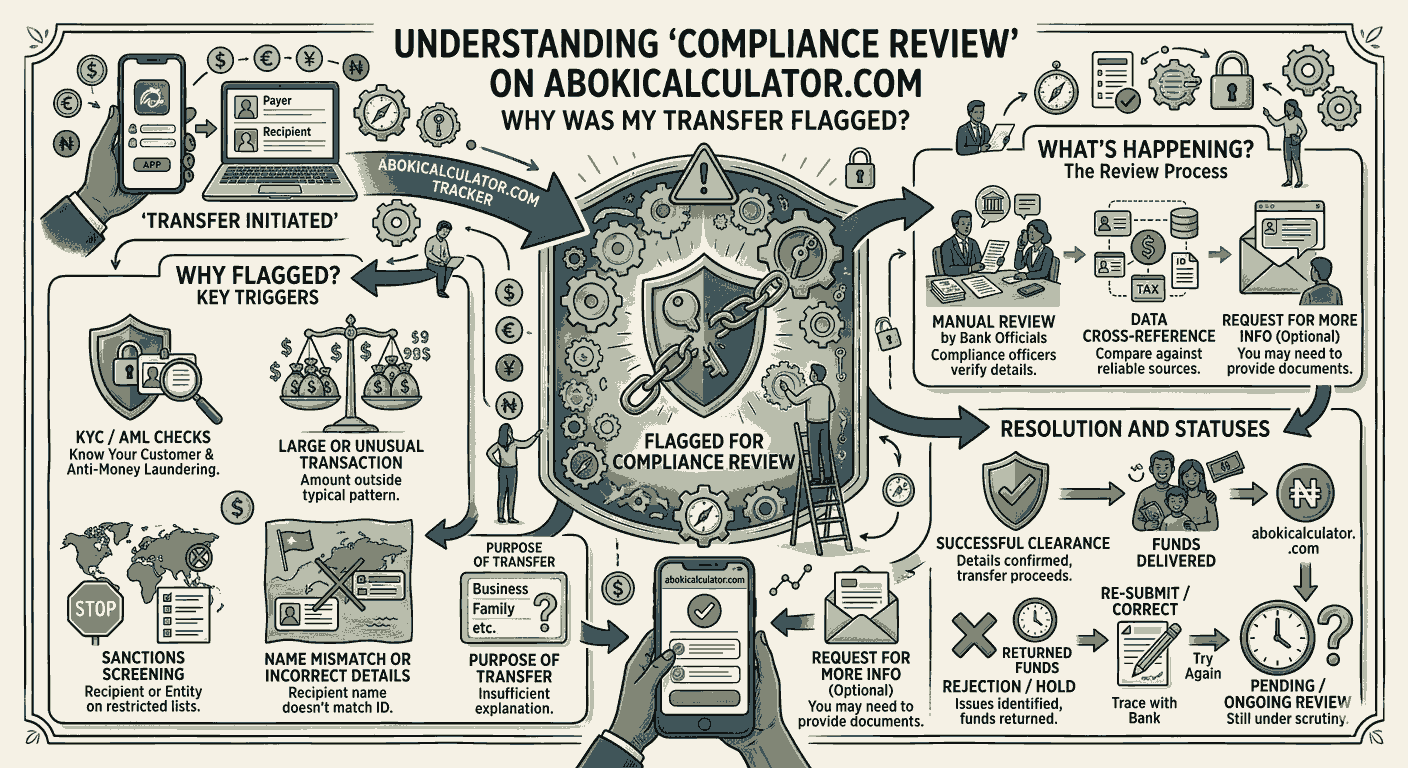
"Under compliance review" means a bank handling your transfer has paused it for a person to check. That could be your bank, an intermediary bank, or the recipient's bank. Banks must screen payments against sanctions lists and watch for money laundering and fraud. When an automatic check flags something, the payment waits until a compliance officer clears it.
Most flagged payments are legitimate. The review usually ends in one of three ways: the payment is released, the bank asks you (or the recipient) for information, or the payment is returned. Rarely, a payment that breaches sanctions law is frozen.
What to do: find out which bank is reviewing it, ask whether it needs anything from you, and answer quickly, completely and consistently. Don't resend the payment or split it into smaller amounts.
On this page
What a compliance review is
Every bank that handles an international payment must check it. The main checks are:
- Sanctions screening: comparing the names, banks and countries in the payment against official sanctions lists, such as those of the United Nations, the US Treasury and the EU.
- Anti-money-laundering (AML) monitoring: looking for payments that don't fit what the bank knows about the customer, or that match known patterns of fraud or laundering.
- Know your customer (KYC): making sure the bank's information about the sender or recipient is complete and up to date.
These checks are mostly automatic. A review happens when the system flags a payment and a person has to look at it before it can continue. The review can happen at any bank in the chain, which is why your own bank sometimes knows no more than "it's being reviewed".
If your bank can see the payment's tracker status, G003 means the recipient's bank is waiting for documents from the recipient. In that case, the recipient needs to contact their bank. Our SWIFT payment tracker explains every status.
Why the bank won't tell you much
It can feel like being stonewalled, but there are legal reasons:
- "Tipping off" rules. In many countries, the law forbids a bank from telling a customer whether it has reported a transaction to the authorities as suspicious. In the US, for example, federal law bars banks from disclosing a suspicious activity report. Staff may not be allowed to say more, even to you.
- The review may be at another bank. Your bank may genuinely not know what an intermediary or recipient bank is checking.
- Screening rules are kept private so they can't be worked around.
What the bank can usually do is tell you whether it needs anything from you, give you a case reference, and pass your documents on.
Common reasons a transfer is reviewed
- A name that resembles one on a sanctions list. Common names can partly match a listed person or company. A person has to confirm it isn't them.
- A vague or missing purpose. "Transfer" or "personal" tells the bank nothing. A specific purpose ("University of Lagos school fees, 2026/27 session") is easier to clear.
- A payment that doesn't fit your usual activity, such as a much larger amount, a new country, or a first payment to a new recipient.
- Missing or inconsistent details, such as the recipient's full name or address, or a sender name that doesn't match the account.
- The countries or banks involved. Each bank rates the risk of countries and corridors in its own way, so some routes get more checks than others.
- Business and personal mixed up, such as a personal-looking payment from a business account, or the reverse.
- Several payments that look split up. A series of smaller payments can look like an attempt to avoid reporting limits.
Never split a payment to avoid a limit or a check. Deliberately breaking up transactions to avoid reporting requirements is called "structuring". In the US it is a federal crime even if the money is completely legitimate, and it is treated as a warning sign everywhere. If you need to send a large amount, send it as one payment and tell your bank why.
What happens to your money
While the payment is under review, the money stays with the bank that is reviewing it. It hasn't disappeared. The review then ends in one of these ways:
| Outcome | What it means for you |
|---|---|
| Released | The payment continues. Most reviews end this way. |
| Information requested | The payment waits until you, or the recipient, answer. Unanswered requests are a common reason payments sit still. |
| Returned | The money comes back, possibly less charges and after a second currency conversion. See why SWIFT payments are returned. |
| Frozen or blocked (rare) | If a payment involves a sanctioned person, company or country, the law can require the bank to freeze it and report it. You would need legal advice. |
There is no standard time limit for a review. The quickest way to shorten one is to give the bank what it asks for, the first time.
What to do, step by step
- Ask which bank is reviewing it: your bank, an intermediary, or the recipient's bank. Get the payment's UETR (tracking reference) and a case reference.
- Ask whether anything is needed from you, and in what form. If the review is at the recipient's bank, tell the recipient to contact their bank.
- Answer completely and consistently. Give the real purpose, the source of the money and your relationship to the recipient. Answers that change between calls cause more delay.
- Send documents through official channels only: your bank's secure messaging, email address or branch. Keep copies and note the dates.
- Don't resend, cancel and resend, or split the payment. A second payment can be reviewed too, and splitting looks worse.
- Follow up with your case reference at the times the bank gives you. If it gives no timeline, ask for one in writing.
Scam warning: banks don't charge a "release fee" or "clearance fee" to finish a compliance review, and they don't ask you to pay one to a third party. Anyone asking you to pay to release a held transfer is very likely a fraudster.
Documents that usually help
Only send what the bank asks for, but it helps to have these ready:
| Purpose of the payment | Documents that usually support it |
|---|---|
| School fees | Admission letter and fee invoice from the school, showing the student's name |
| Family support | A short explanation of your relationship and the reason for the payment |
| Paying for goods or services | Invoice, contract or order confirmation |
| Freelance or salary income | Contract, invoice or payslip from the payer |
| Property or large purchase | Sale agreement, and proof of the payee's identity |
| Where the money came from | Bank statements showing the funds arriving, payslips, sale documents or a loan agreement |
For more on the source-of-funds question, see why your bank is asking for source of funds.
If nothing happens: escalating
- Make a formal complaint to your bank, in writing, quoting the case reference and UETR. Ask for the bank's complaint reference.
- Use your regulator's complaint route if the bank doesn't resolve it. In Nigeria, the Central Bank of Nigeria says you must first complain to your bank and allow two weeks. After that, you can take it to the CBN's Consumer Protection Department, with evidence that you complained to the bank first. In other countries, use the bank regulator's or ombudsman's complaint service.
A regulator can make a bank handle your complaint properly. It can't usually force a bank to release a payment that it has a legal duty to hold.
Reducing the chance next time
- Give a specific purpose on every international payment.
- Use full, correct names and addresses for both sender and recipient, exactly as the banks hold them.
- Tell your bank in advance about a large or unusual payment, and have documents ready.
- Keep your own details up to date with your bank, including ID, address and occupation.
- Check the recipient's bank details with our SWIFT code checker, IBAN validator or NUBAN validator.
Send the right details the first time
Choose send or receive and the country. The tool lists every detail to give or ask for, including SWIFT/BIC, IBAN and local bank codes, with links to the right checker.
Open What Bank Details Do I Need?For Nigerian users
- Nigeria is no longer on the FATF "grey list". The Financial Action Task Force, which sets global anti-money-laundering standards, removed Nigeria from its list of jurisdictions under increased monitoring on 24 October 2025, after adding it in February 2023. The grey list was never the FATF's "high-risk" (black) list, which has three countries: North Korea, Iran and Myanmar. Individual banks still set their own country risk ratings, so some payments will still be checked closely.
- Receiving money from abroad: your bank may ask about the purpose of an incoming payment or the sender before it credits you. Reply quickly. It's often the only thing holding the money.
- Sending money abroad: expect questions about purpose and source of funds, and keep supporting documents, such as school invoices, handy.
- If your bank doesn't resolve a complaint within two weeks, escalate to the CBN's Consumer Protection Department as described above.
Related questions
What does it mean when a bank says a transfer is under compliance review?
A bank handling the payment has paused it so that a person can check it against sanctions lists and anti-money-laundering and fraud rules. It can be your bank, an intermediary bank or the recipient's bank. Most reviewed payments are legitimate and are released, though the bank may first ask for information.
How long does a compliance review take?
There is no standard time limit. Simple checks can clear quickly, while reviews that need information from you or the recipient wait until the bank gets it. Ask the bank for a case reference and an expected timeline in writing, and answer any request quickly and completely.
Why won't my bank tell me why my transfer is being reviewed?
The review may be at another bank, and screening rules are kept private so they cannot be worked around. In many countries the law also forbids banks from telling a customer whether they have reported a transaction as suspicious. The bank can usually still tell you whether it needs anything from you.
Can the bank keep my money?
Normally no. A review ends with the payment being released or returned. Only in rare cases, such as a payment involving a sanctioned person, company or country, can the law require a bank to freeze the funds and report them, and in that situation you should get legal advice.
Should I send the money again in smaller amounts?
No. Resending can put a second payment under review, and splitting a payment into smaller amounts to avoid limits or checks is called structuring. In the US it is a federal crime even when the money is legitimate. Send one payment and give the bank the information it asks for.
Is Nigeria still on the FATF grey list?
No. The Financial Action Task Force removed Nigeria from its list of jurisdictions under increased monitoring on 24 October 2025, having added it in February 2023. Banks still set their own country risk ratings, so some payments involving any country may still be checked closely.
Where can I complain in Nigeria if my bank does not resolve it?
First complain to your bank in writing and allow two weeks, as the Central Bank of Nigeria requires. If the bank does not resolve it, you can escalate to the CBN's Consumer Protection Department with details of the transaction and evidence that you first complained to the bank.
Keep going
Sources
- Financial Action Task Force, outcomes of the October 2025 plenary (22–24 October 2025), as reported by ComplyAdvantage and TEMPLARS: Nigeria, South Africa, Mozambique and Burkina Faso removed from increased monitoring; the call-for-action list unchanged.
- Central Bank of Nigeria, Complaints management: complain to the bank first, allow two weeks, then escalate to the Consumer Protection Department.
- United States Code, 31 U.S.C. § 5324 (structuring prohibited) and 31 U.S.C. § 5318(g) (confidentiality of suspicious activity reports).
- Tracker status
G003and other codes, as sourced on our SWIFT payment tracker.
This guide explains compliance reviews in general. It is not legal or financial advice. If a payment has been frozen or you have been told it involves sanctions, get advice from a qualified lawyer.