Guides · Transfer Problems
Why Is My Bank Asking for Source of Funds for a Transfer? What It Means and What to Send
It's a legal check, not an accusation. Here's what "source of funds" really means, how it differs from "source of wealth", which documents prove it, and a cover note you can copy.
Quick answer
Your bank is asking where the money you're sending came from, for example your salary, a property sale, a business, or a gift from family. Anti-money-laundering rules require banks to understand the source of money in some payments, especially large or unusual ones, before they process them.
It doesn't mean you're suspected of a crime. It means the payment needs a paper trail. Send documents that show the money arriving in your account from a legitimate source, with a short note that ties them together, and the bank can usually clear the payment.
Don't ignore the request, split the payment into smaller amounts, or send documents that aren't genuine. Each of those makes things much worse.
On this page
Source of funds vs source of wealth
Banks use two similar-sounding terms. Knowing which one they want saves time:
| Source of funds | Source of wealth | |
|---|---|---|
| The question | Where did this money come from, and how did it reach your account? | How did you build up everything you own? |
| Scope | One payment or deposit | Your overall net worth |
| Typical proof | Statement showing the money arriving, plus a payslip, sale agreement or gift letter | Career history, business ownership, investments, inheritance |
| Usually asked of | Anyone making a large or unusual payment | Wealthy clients, private banking customers and politically exposed persons |
The Wolfsberg Group, an association of global banks that publishes financial-crime guidance, describes source of funds as the origin and means of transfer of the money involved. It describes source of wealth as the activities that generated the customer's overall net worth. For most transfers, your bank wants source of funds.
Why your bank is asking
International anti-money-laundering standards, set by the Financial Action Task Force (FATF) and written into each country's law, require banks to know their customers and to take a risk-based approach: more checks where the risk is higher. For politically exposed persons (senior public officials, their families and close associates), the standards specifically require banks to establish the source of wealth and the source of funds.
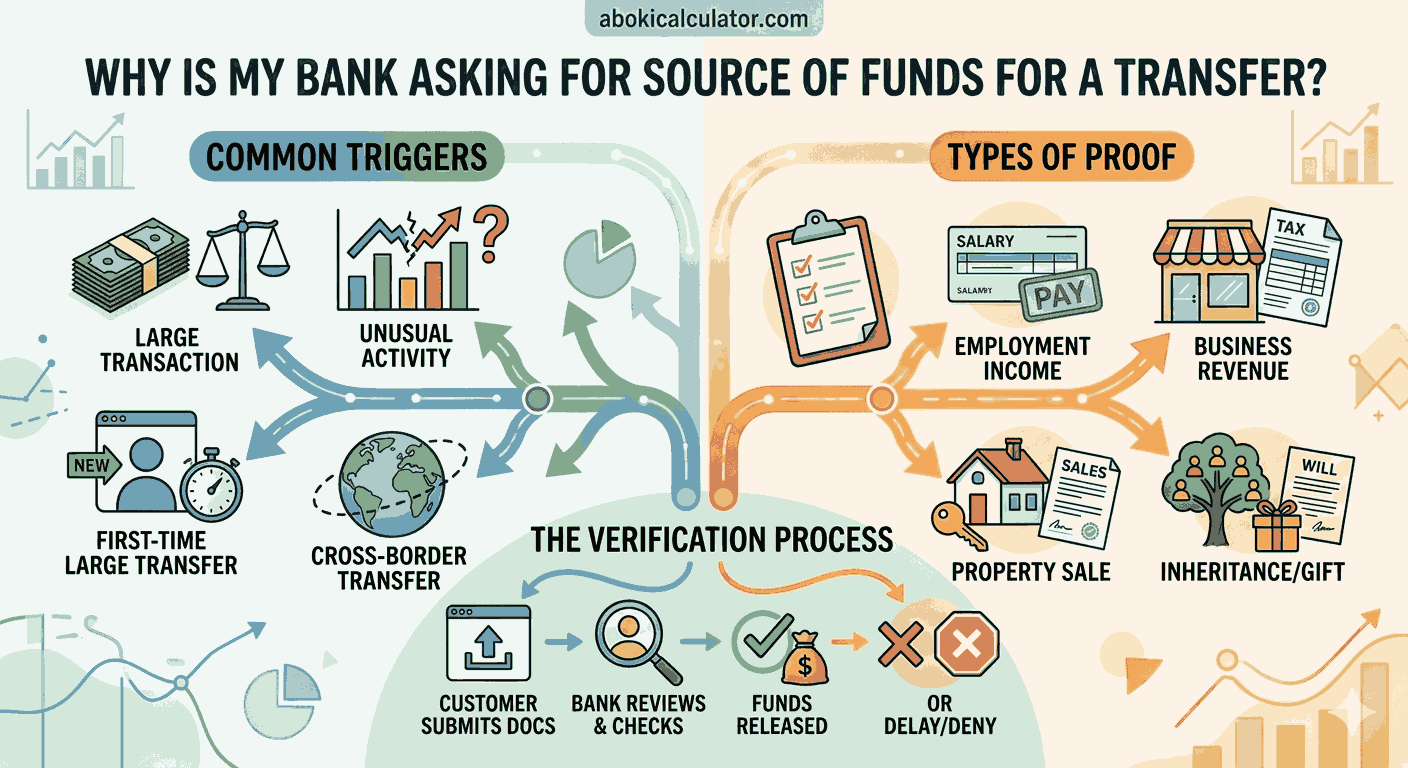
Common reasons a payment triggers the question:
- A large payment, or one that's out of character for your account.
- Money that arrived recently, especially a large cash deposit, or money from someone else, just before the transfer.
- A new account or new customer with little history.
- A vague purpose, or a purpose that doesn't match the amount.
- A request passed on from another bank in the payment chain, such as an intermediary or the recipient's bank.
- Politically exposed person status, for you or someone connected to you.
There is no single worldwide amount that triggers the question. Each bank sets its own risk rules within the law. If the payment is also on hold, see what a compliance review means.
Documents by where the money came from
The strongest evidence shows two things: the money arriving in your account (a bank statement), and why it arrived (the document behind it). Send what your bank asks for, and label each file clearly.
| Where the money came from | Documents that usually prove it |
|---|---|
| Salary or wages | Recent payslips, an employment letter or contract, and bank statements showing the salary credits |
| Savings built up over time | Statements covering the period the savings built up, showing regular income going in |
| Business or freelance income | Invoices and the matching payments on your statements, business account statements, and financial accounts or tax filings |
| Sale of property, a car or other asset | Sale agreement, proof you owned the asset, and the statement showing the sale proceeds |
| Investments or shares sold | Statement from your broker or fund showing the sale or payout, and the transfer into your bank account |
| Gift or support from family | A signed gift letter from the giver (name, relationship, amount, date, and that it's a gift, not a loan), the giver's ID, and statements showing the transfer from their account |
| Several relatives contributing (e.g. school fees) | A short list of who gave what, with a statement line for each contribution |
| Loan | Loan agreement and the statement showing the loan paid in |
| Inheritance | Will or letters of administration, the estate's payment to you, and the statement showing it |
| Cash you deposited | Evidence of where the cash came from (for example sales records or a withdrawal slip), plus the deposit record |
Only share documents through your bank's official channels: its secure messaging, a published email address, or a branch. Blank out anything the bank doesn't need, such as unrelated account numbers, but never change amounts, names or dates.
A cover note you can copy
A short explanation helps the reviewer connect your documents. Fill in the parts in blue, keep it factual, and attach the documents it mentions.
What not to do
- Don't ignore the request. The payment will usually be held and then returned, and your account may be reviewed too.
- Don't split the payment into smaller amounts to avoid the question. Deliberately breaking up transactions to avoid checks is called "structuring". In the US it's a federal crime even when the money is legitimate, and banks everywhere treat it as a red flag.
- Never send altered or made-up documents. Forged payslips or letters are fraud, and banks check.
- Don't give different explanations to different people. Inconsistent answers cause more delay than any missing document.
- Don't pay anyone to "clear" the review. Banks don't charge release fees. Anyone who asks for one is almost certainly a scammer.
What happens after you respond
- Accepted: the payment continues. There's no standard review time, so ask the bank for an expected date and a case reference.
- More questions: answer them all in one reply if you can.
- Declined: if the bank can't get comfortable with the source, it can refuse the payment. The money is usually returned. See why SWIFT payments are returned.
Complain first to your bank if you think you've been treated unfairly. In Nigeria, if your bank doesn't resolve it within two weeks, you can escalate to the CBN's Consumer Protection Department.
Check the recipient's details while you wait
A payment that also has a detail error takes longer to fix. Choose the country and see exactly which details are needed, with links to the SWIFT code, IBAN and NUBAN checkers.
Open What Bank Details Do I Need?For Nigerian users
- Nigeria is no longer on the FATF grey list. It was removed on 24 October 2025. Banks still apply their own risk rules, so source-of-funds questions will continue for large or unusual payments.
- School fees and family contributions are the most common cases. Keep the school's admission letter and invoice, and a record of each relative's contribution, before you pay.
- Cash deposits made shortly before a transfer attract the most questions. Keep receipts or sales records that show where the cash came from.
- Receiving money from abroad: your bank may ask the purpose of an incoming payment and who sent it. Answer promptly, since it's often the only thing holding the credit.
Related questions
Why is my bank asking for source of funds?
Anti-money-laundering rules require banks to understand where money comes from in some payments, particularly large ones, ones that don't fit your usual activity, or ones funded by a recent cash deposit or money from someone else. It is a standard check, not an accusation, and it can also be passed on from another bank in the payment chain.
What is the difference between source of funds and source of wealth?
Source of funds is where the specific money in a payment came from and how it reached your account, such as a salary, a sale or a gift. Source of wealth is how you built up everything you own overall. For most transfers, banks ask for source of funds; source of wealth checks are mainly for wealthy clients and politically exposed persons.
What documents prove source of funds?
Documents that show the money arriving in your account and the reason it arrived: bank statements plus payslips for salary, a sale agreement for an asset sale, invoices for business income, a signed gift letter and the giver's ID and statement for a gift, or a loan agreement for a loan. Send what your bank asks for through its official channels.
How do I prove money given to me by family?
Ask the giver for a signed gift letter stating their name, your relationship, the amount, the date and that it is a gift rather than a loan, with a copy of their ID. Include the bank statement lines showing the money leaving their account and arriving in yours. For several contributors, list who gave what.
What happens if I don't provide source of funds?
The payment is usually held and then returned, and the bank may review your account more generally. If you cannot provide a document the bank asks for, tell the bank and offer an alternative, rather than ignoring the request.
Can I send the money in smaller amounts instead?
No. Deliberately splitting a payment to avoid checks or reporting is called structuring. In the US it is a federal crime even when the money is legitimate, and banks everywhere treat it as a red flag. Send one payment and answer the bank's questions.
Is Nigeria still on the FATF grey list?
No. The Financial Action Task Force removed Nigeria from its list of jurisdictions under increased monitoring on 24 October 2025. Banks still set their own risk rules, so source-of-funds questions continue for large or unusual payments.
Keep going
Sources
- The Wolfsberg Group, FAQs on Source of Wealth and Source of Funds (August 2020): definitions of source of wealth and source of funds, and the risk-based approach to corroboration.
- Financial Action Task Force, Guidance on politically exposed persons (Recommendations 12 and 22): reasonable measures to establish source of wealth and source of funds.
- FATF October 2025 plenary outcome (Nigeria removed from increased monitoring), as reported by ComplyAdvantage and TEMPLARS.
- United States Code, 31 U.S.C. § 5324 (structuring).
- Central Bank of Nigeria, Complaints management.
This guide explains source-of-funds requests in general. It is not legal or financial advice, and each bank decides what evidence it needs. If your account has been frozen or you have been told a payment involves sanctions, get advice from a qualified lawyer.