
Guides · Country Banking · United States
ABA Routing Number Explained: What It Is, Where to Find It and When It Changes
Nine digits that decide which US bank gets your money. Why your bank may have several, when one stops working, and whether it's safe to share.
Quick answer
An ABA routing number (also called a routing transit number, RTN or ABA number) is a 9-digit number that identifies a US bank or credit union in a payment. It tells the system which institution holds the account. Your account number then tells that institution which account to use.
You need it for direct deposit, automatic bill payments, ACH transfers, domestic wire transfers and cheques. You'll find it on the bottom left of a cheque, in your banking app, or on your bank's website. A bank can have more than one, for example one for ACH and another for wires, so always use the number your bank gives for that type of payment.
Routing numbers are used only inside the United States. Payments from abroad use the bank's SWIFT code.
On this page
Routing number vs account number
| Routing number | Account number | |
|---|---|---|
| Identifies | The bank or credit union | Your individual account |
| Length | Always 9 digits | Varies by bank |
| Shared with others? | Yes, by every customer of that bank (or region) | No, unique to you |
| Secret? | No, it's printed on every cheque and listed publicly | Private: share only with people you trust to pay or debit you |
| Has a built-in check? | Yes, the last digit is a check digit | Depends on the bank |
What the nine digits mean
- Digits 1–4, the Federal Reserve routing symbol. The first two digits show which of the 12 Federal Reserve districts the bank is in: 01 (Boston) to 12 (San Francisco). Numbers starting 21–32 are thrift institutions, such as savings banks and credit unions. Numbers starting 61–72 are used for electronic payments.
- Digits 5–8, the institution. These tell the bank apart from others in the same district.
- Digit 9, the check digit. It's worked out from the first eight digits, so most typing mistakes produce a number that fails the check.
Our ABA routing number checker shows the full district table and runs the check-digit test on any number, with the working shown.
Who issues routing numbers?
The routing number was devised by the American Bankers Association (ABA) in 1910 and adopted by the banking industry in 1911, originally to sort paper cheques. The ABA's rules are managed by its Routing Number Administrative Board. The day-to-day issuing is done by an Official Registrar, currently LexisNexis Risk Solutions.
Under the ABA's policy:
- A regular routing number can go only to an institution that is eligible to hold an account at a Federal Reserve Bank, or to a unit of the US federal or a state government.
- Each institution gets a main routing number and can have up to nine more. More than that needs the Board's approval.
- The number belongs to the system, not the bank. A bank can't sell or transfer it.
This is why payment apps and fintech companies that aren't banks usually show you the routing number of a partner bank that holds your money.
Where to find your routing number
On a cheque: the line of special characters along the bottom. The first group, on the left, is the routing number:
⑆ 9 digits ⑆Routing numberAccount no. ⑈Account number0000Cheque number- In your banking app or online banking: usually under account details, often labelled "routing number" or "direct deposit details".
- On your bank's website: many banks list their numbers, including a separate number for wires.
- From the Federal Reserve or the ABA: the Federal Reserve Banks publish a routing number directory with separate FedACH and Fedwire data, and the ABA runs an official lookup.
Don't copy a routing number from a random website list. Lists go out of date when banks merge, and a number that belongs to the wrong bank sends your payment to the wrong place.
Why your bank may have several routing numbers
- Payment type: the number for ACH and direct deposit can differ from the one for wire transfers. The Federal Reserve even publishes routing data for FedACH and Fedwire separately.
- Where you opened the account: some large banks use different numbers for different states or regions, often left over from banks they bought.
- Mergers: after a merger, the combined bank may still use numbers from the banks it absorbed, at least for a while.
So "the routing number for Bank X" may not exist as one number. Use the one shown on your account for your type of payment.
When a routing number changes
Your routing number can change even though you did nothing, usually because your bank merged with or was bought by another bank. Under the ABA's policy:
- The surviving bank becomes responsible for all the routing numbers of the banks involved and must choose one main number.
- Within a year of the merger, it should tell the Registrar which numbers it will combine or retire.
- Once a number is retired, a cheque or electronic payment that uses it can be rejected or returned, and the number can later be given to a different bank.
What to do: if your bank tells you your routing number is changing, update it wherever money is paid in or taken out: your employer's direct deposit, benefits, tax refunds, bill payments and payment apps. Keep an eye on the first payments after the change.
Is it safe to share your routing number?
The routing number on its own isn't secret: it's printed on every cheque and listed in public directories. The risk comes from the routing number and account number together, which is enough to send money to you and, with your authorisation, to set up debits from your account.
- Do share them with an employer, a government agency, or a company you've agreed to pay by direct debit.
- Be careful with anyone who contacts you out of the blue asking for them, or who "overpays" you and asks for money back.
- Check your statements. If a company takes money you didn't authorise, your bank can usually return it. Under Nacha's rules, consumers have up to 60 days. See ACH explained.
- Check requests to change bank details. If a supplier or colleague emails new routing details, phone them on a number you already know before paying.
Which details each payment needs
| Payment | What to give or ask for |
|---|---|
| Direct deposit (salary, benefits) | ACH routing number, account number, account type (checking or savings), name |
| Automatic bill payment (ACH debit) | ACH routing number, account number, name, and your authorisation |
| Domestic wire transfer | Wire routing number (may differ), account number, name, sometimes the bank's address |
| International wire into a US account | The bank's SWIFT code and your account number. Some senders also ask for the wire routing number. Follow your bank's incoming-wire instructions. |
| Cheque | Already printed on the cheque |
Check the format before you submit: our ACH routing number checker also shows ACH settlement times, and the Fedwire routing code checker shows whether Fedwire is open now.
Check a routing number in seconds
Type the nine digits. The checker tests the check digit, shows the working, and tells you what the first two digits mean. It runs in your browser, and nothing you type is sent anywhere.
Open the ABA routing number checkerFrom outside the US, and for Nigerian users
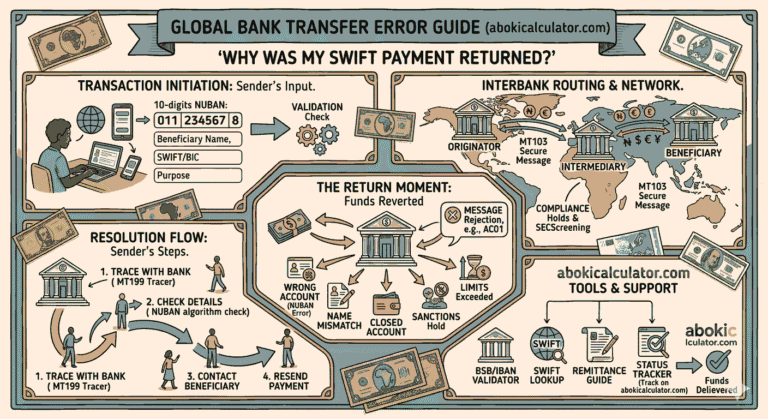
- Banks outside the US don't have ABA routing numbers. A Nigerian account is identified by a 10-digit NUBAN, and money from abroad reaches it using the bank's SWIFT code. See bank code vs SWIFT code.
- Receiving US dollars into a Nigerian bank: some banks give customers dollar-receiving instructions that name a US correspondent bank, sometimes with that bank's routing number or SWIFT code, plus your bank's account at the correspondent. Use exactly the instructions your bank gives you. Our correspondent bank checker explains how this works.
- A platform or client asks for a "routing number": they want to pay a US bank account by ACH or wire. A Nigerian account can't take that directly. You need a US account, or a service that provides US account details, and then an international transfer home.
- Never make up or "borrow" a routing number to get past a form. The payment will fail or go to someone else's bank.
For the full list of details needed in any country, use What Bank Details Do I Need?
Common mistakes
- Using the ACH number for a wire, or the other way round.
- Using a routing number from another state or region of the same bank.
- Keeping an old routing number after a bank merger on direct deposits and bill payments.
- Mixing up the routing and account numbers from a cheque.
- Giving a routing number for an international payment when the sender needs the SWIFT code.
- Trusting a passing check digit as proof. It only proves the number is correctly formed.
Related questions
Is an ABA number the same as a routing number?
Yes. ABA number, ABA routing number, routing transit number (RTN) and routing number all mean the same 9-digit number that identifies a US bank or credit union. ABA stands for the American Bankers Association, which created the system in 1910.
Why does my bank have more than one routing number?
A bank can have a main routing number and up to nine more under the ABA's policy. It may use different numbers for ACH and for wire transfers, for different states or regions, or keep numbers from banks it has taken over. Use the number your bank shows for your account and the type of payment you are making.
Can a routing number change?
Yes, usually after a bank merger or takeover. The surviving bank decides which numbers to keep, and a retired number can cause payments to be rejected or returned and may later be given to another bank. If your bank tells you your number is changing, update your direct deposits and automatic payments.
Is it safe to give out my routing number?
The routing number on its own is public: it is printed on every cheque. Your routing and account numbers together let someone pay you and, with your authorisation, set up debits, so share them only with people and companies you trust to pay you or that you have agreed to pay. Report any debit you did not authorise to your bank quickly.
Do I need a routing number for an international transfer?
To send money out of the US, you give your bank the foreign recipient's details, such as a SWIFT code and account number or IBAN, not a US routing number. To receive a wire from abroad into a US account, the sender usually needs your bank's SWIFT code and your account number, and some also ask for the wire routing number.
Do Nigerian banks have routing numbers?
Not ABA routing numbers, which exist only for US institutions. A Nigerian account is identified by a 10-digit NUBAN, and money from abroad uses the bank's SWIFT code. Some Nigerian banks' US-dollar receiving instructions include a US correspondent bank's details, so use exactly what your bank provides.
How can I check if a routing number is valid?
Check the format and check digit with our ABA routing number checker, which multiplies the digits by 3, 7 and 1 and tests whether the total divides by 10. A pass only means the number is correctly formed. To confirm which bank it belongs to, ask the bank or use the Federal Reserve's routing directory or the ABA's official lookup.
Keep going
Sources
- American Bankers Association, Routing Number Policy & Procedures (revised September 2020; published by the Official Registrar, LexisNexis Risk Solutions): history, eligibility, additional numbers, mergers and retirement.
- Federal Reserve, Regulation CC, Appendix A (routing symbol and Federal Reserve districts).
- Federal Reserve Financial Services, routing number directory (separate FedACH and Fedwire data).
- Nacha Operating Rules: return time frame for unauthorised consumer debits, as covered in our ACH guide.
This guide explains US routing numbers in general. It is not financial or legal advice. Confirm routing details with the bank or the account holder before you send money.