Guides · International Money & Remittance
How International Money Transfers Work, Step by Step
Your money almost never crosses the border. Here's what really happens after you press Send, who takes a cut on the way, and why less can arrive than you sent.
Quick answer
An international money transfer moves value from a sender in one country to a recipient in another through a bank, a money transfer company or a payment app. In almost every case the money itself does not travel. Instead, institutions that already hold money in both countries adjust their balances: one takes your money in, and another pays the recipient from money it already holds.
Every transfer goes through the same five stages: you pay in, the provider checks you and the payment, the money is converted into the recipient's currency, the value travels between institutions, and the recipient is paid out. The cost comes from fees and the exchange rate. The time depends mostly on checks, cut-off times and the receiving bank.
On this page
The five stages of every international transfer
- You pay inYou give the provider money by bank transfer, debit card, cash at an agent, or from an account balance. This is also when the provider's sending fee is charged.
- ChecksBy law the provider must know who you are and screen the payment: identity checks, sanctions lists and anti-money-laundering rules. Larger or unusual payments may need extra questions, such as where the money came from.
- ConversionIf the recipient gets a different currency, someone converts it at an exchange rate. That rate usually includes a margin above the mid-market rate, which is a cost even when no fee is shown.
- The value travelsInstitutions pass instructions and adjust balances with each other, using one of the three routes below. Banks along the way may deduct their own charges.
- PayoutThe recipient is paid into a bank account, into a mobile money wallet, or in cash at a pickup point. The receiving bank may take a fee or run its own checks before crediting the account.
The three ways the money travels
Moving money between two countries is really a bookkeeping problem: how does a pound in London become naira in Lagos without anyone carrying cash? There are three main answers.
1. Bank wire through Swift
Your bank sends a payment instruction over Swift, a secure messaging network that banks use to talk to each other. Swift itself does not move money. It carries the message.
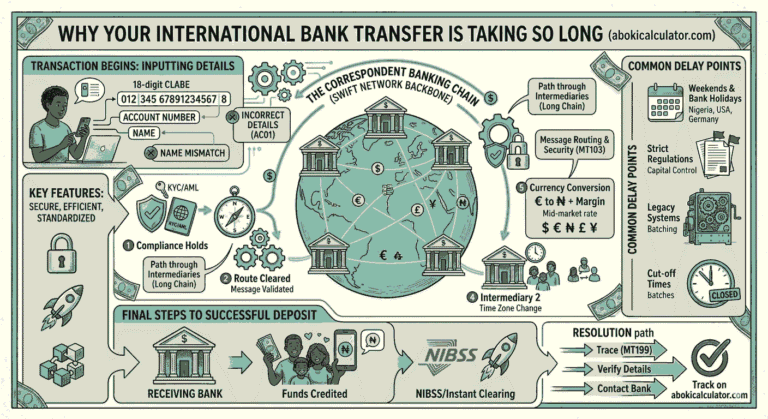
The money moves between accounts that banks hold with each other. If your bank and the recipient's bank have no account relationship, one or more correspondent (intermediary) banks sit in between, and each can deduct a fee.
2. Money transfer company or app
Remittance companies and transfer apps often hold money in accounts in both countries. They take your money in one country and pay the recipient from money they already keep in the other. This is called prefunding.
They settle the difference between countries later, in bulk. This is why they can often pay a local bank account, a mobile wallet or a cash agent quickly.
3. Linked regional systems
Some regions connect their payment systems so a transfer works almost like a domestic one. The best-known example is SEPA, which lets euro transfers move between participating European countries using just an IBAN.
These schemes cover specific regions and currencies. Nigeria is not part of SEPA. Check a country on our SEPA eligibility checker.
From the sender's side the difference is mostly invisible. What changes is who converts the currency, how many institutions touch the payment, and who can take a fee. A bank wire can pass through several banks. A money transfer company usually controls the whole journey.
| Bank wire (Swift) | Transfer company or app | Regional scheme (e.g. SEPA) | |
|---|---|---|---|
| Recipient receives in | A bank account | A bank account, mobile wallet or cash | A bank account in the region |
| Details needed | Name, account number or IBAN, bank name, SWIFT/BIC | Usually local details: name, account number, bank | Name and IBAN |
| Where extra costs hide | Exchange rate margin, intermediary and receiving bank deductions | Exchange rate margin | Usually few, if no currency conversion |
| Main sources of delay | Checks, cut-off times, intermediaries, receiving bank | Checks, payout-partner hours | Cut-off times (instant options exist) |
Follow $1,000 from New York to Lagos
Round numbers for illustration, not real fees or today's ratesHere is a bank wire, because it has the most steps. The sender chooses to share charges (explained below), and the money is paid into a naira account. Assume the mid-market rate is ₦1,500 per $1.
| Stage | What happens | Amount |
|---|---|---|
| Pay in | Sender's bank charges a $35 sending fee on top | Sender pays $1,035 |
| Travel | An intermediary bank deducts $20 as the payment passes through | $980 arrives |
| Convert | Receiving bank converts at ₦1,470 per $1 (2% below mid-market) | 980 × 1,470 |
| Payout | Recipient is credited | ₦1,440,600 |
At the mid-market rate, $1,000 is worth ₦1,500,000. Here is where the difference went:
| Cost | Naira | Share of $1,000 |
|---|---|---|
| Sending fee ($35) | ₦52,500 | 3.50% |
| Intermediary deduction ($20) | ₦30,000 | 2.00% |
| Exchange rate margin (980 × ₦30) | ₦29,400 | 1.96% |
| Total cost | ₦111,900 | 7.46% |
What this means: the sender sees one fee ($35), but the recipient feels three costs. Only one of them was on the sender's receipt. The other two happened after the money left, which is why "I sent $1,000" and "they received less than expected" are both true.
OUR, SHA and BEN. On a bank wire the sender chooses who pays the banks' charges. OUR: the sender pays all charges, so the full amount should arrive (some receiving banks still charge a fee). SHA (shared): the sender pays their own bank, and intermediary and receiving bank fees come out of the amount. BEN: all charges come out of the amount the recipient gets.
To see the same maths for real quotes, including how much to send so that a set amount arrives, use the calculator below.
Compare real quotes with the Remittance Calculator
Enter the amount, each provider's fee and the rate they offer. The calculator fills in a mid-market reference rate and shows, for up to three providers, what you pay, what the recipient gets and the total cost. It can also work backwards from the amount the recipient must receive.
Open the Remittance CalculatorWho takes a cut
The World Bank, which tracks remittance prices worldwide, counts the cost of a transfer as the fee plus the exchange rate margin. The United Nations target is to bring the average cost of sending money home to 3% or less by 2030. Here is every place a cost can appear:
| Cost | Who charges it | Visible to the sender? |
|---|---|---|
| Sending fee | Your bank or provider | Yes, on the quote |
| Exchange rate margin | Whoever converts the currency | Only if you compare with the mid-market rate |
| Intermediary bank fee | Correspondent banks on a wire | Often not in advance |
| Receiving fee | The recipient's bank or payout agent | Usually not |
| Card or funding fee | Your card issuer, if you pay by card | Sometimes |
The exchange rate margin is the easiest cost to miss. Our guide Exchange Rate vs FX Spread shows how to measure it on any quote.
How long it takes, and why
Transfers take anything from seconds to several working days. The network is rarely the slow part. Swift reports that 90% of cross-border payments on its network reach the recipient's bank in under an hour, and that delays often happen after the payment arrives, before the receiving bank credits the customer.
What usually slows a transfer down:
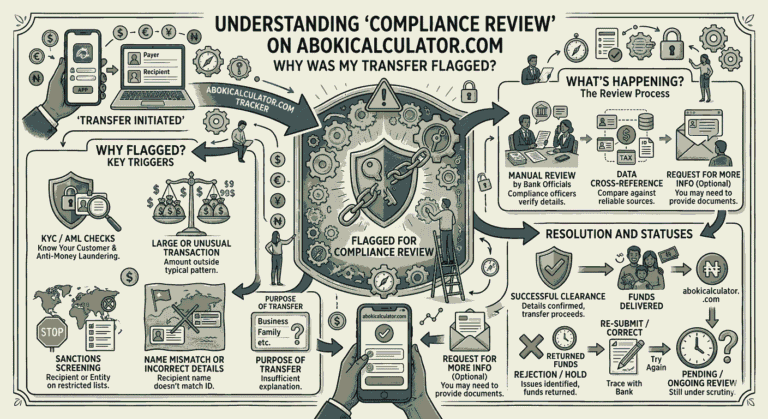
- Checks: identity, sanctions or source-of-funds questions, at either end. See what a compliance review means.
- Cut-off times, weekends and public holidays in either country.
- Intermediary banks on a wire route. Swift says 86% of its payments go direct or through a single intermediary. Our correspondent bank checker shows whether yours is likely to use one.
- Wrong or incomplete details, which can get a payment held or sent back.
Waiting longer than expected? Start with why an international bank transfer is taking so long. For a Swift payment, the SWIFT payment tracker helps you find the payment's unique reference (UETR) and write a trace request to your bank.
The details you need
For most international transfers you need the recipient's full name as it appears on the account, their account number (or IBAN in countries that use one), and the bank's name. A bank wire also needs the bank's SWIFT/BIC code, and sometimes its address. Transfer apps that pay out locally usually ask for local details instead.
Our What Bank Details Do I Need? tool lists the exact details for any country. Before you send, check the format with the SWIFT code checker, the IBAN validator or, for a Nigerian account, the NUBAN validator. A valid format doesn't prove the account belongs to the right person, so confirm the details with the recipient directly.
Staying safe
- Use a licensed provider. Check your country's regulator. In the UK, that is the Financial Conduct Authority's register. In Nigeria, money transfer operators are licensed by the Central Bank of Nigeria.
- Get the quote in writing before you pay. In the US, remittance providers must tell you the exchange rate, fees and the amount the recipient will get before you pay, and you generally have 30 minutes after paying to cancel.
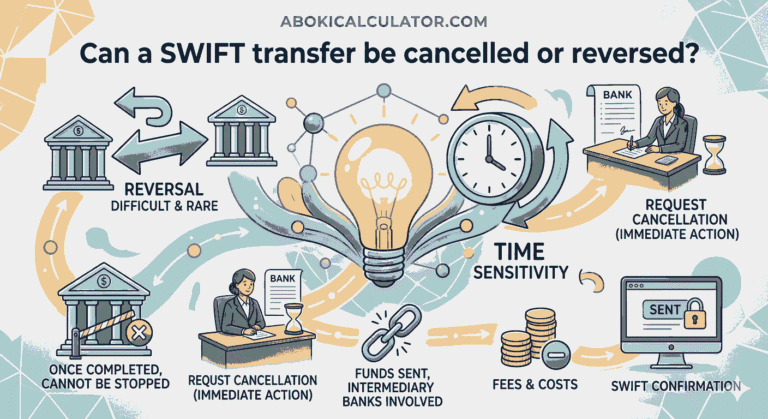
- Treat sent money as gone. Once a transfer is paid out, getting it back is hard and not guaranteed. Read whether a Swift transfer can be cancelled or reversed.
- Never send money to someone you have only met online, or because of an urgent message asking you to change bank details. Confirm new details by phone on a number you already know.
For Nigerian users
Receiving money from abroad
- Through a money transfer operator: naira only. Under the Central Bank of Nigeria's revised guidelines for international money transfer services (31 January 2024), licensed international money transfer operators (IMTOs) pay recipients in Nigeria in naira, into a bank account or in cash, at the prevailing rate in the Nigerian Foreign Exchange Market. Payouts above the equivalent of $200 must go into a bank account, and cash payouts need acceptable ID.
- Tighter settlement from May 2026. A CBN circular of 24 March 2026 requires IMTOs to settle remittances through designated naira settlement accounts with authorised dealer banks, from 1 May 2026.
- Through a bank wire: a bank-to-bank Swift transfer is a different channel. If you want to keep the money in dollars or another foreign currency, ask your bank whether it can be credited to your domiciliary account in that currency, and what it charges to receive.
Because IMTO payouts are converted into naira, the rate you are paid at matters as much as the fee. Compare it with today's figures on our official vs black market exchange rate page.
Sending money out of Nigeria
The same 2024 guidelines limit IMTOs to inbound transfers, so they cannot send money out of Nigeria. Outward transfers go through your bank or other authorised channels, which may ask for documents and the purpose of the payment. See why your bank may ask for source of funds.
Rules change. Check with your bank or provider before you rely on any of the above. We last checked the CBN's circular list on 24 September 2026.
Common mistakes
- Comparing fees only. A low or zero fee can come with a poor exchange rate. Compare the amount that arrives.
- Assuming the full amount arrives on a wire. With SHA or BEN charges, intermediary and receiving banks can deduct fees on the way.
- Name mismatches. A recipient name that doesn't match the account can hold up or return a payment. See why Swift payments are returned.
- Sending just before a weekend or holiday and expecting it the same day.
- Treating a format check as proof. A valid SWIFT code or account number format doesn't prove the account belongs to your recipient.
Related questions
Does money physically move from one country to another?
Almost never. Banks and transfer companies keep money in accounts in different countries. When you send money, one institution takes your money in and another pays the recipient from money it already holds, and they settle up with each other later. Networks such as Swift carry the payment instructions, not the money itself.
How long does an international money transfer take?
Anything from seconds to several working days. Swift reports that 90% of cross-border payments on its network reach the recipient's bank in under an hour, but checks, cut-off times, weekends, public holidays, intermediary banks and the receiving bank can all add time. Money transfer apps that pay out from local accounts are often faster than bank wires.
Why did the recipient get less than I sent?
Usually because of one or more costs you didn't see on the quote: an exchange rate below the mid-market rate, fees deducted by intermediary banks on a wire sent with shared (SHA) or beneficiary (BEN) charges, or a fee charged by the receiving bank or payout agent.
Can I cancel an international transfer?
Sometimes, but only before it is paid out. In the US, remittance providers generally must let you cancel within 30 minutes of paying, as long as the money hasn't been collected or deposited. After that, and in most other cases, your bank can only ask the receiving bank to return the money, and that is not guaranteed.
Can someone in Nigeria receive dollars through a money transfer operator?
Not as dollars. Under the Central Bank of Nigeria's January 2024 guidelines, licensed international money transfer operators pay recipients in Nigeria in naira only, into a bank account or in cash, and payouts above the equivalent of $200 must go into a bank account. A bank-to-bank wire is a different channel, so ask your bank whether it can credit a domiciliary account in the original currency.
What is the cheapest way to send money abroad?
It depends on the amount, the countries, how the recipient wants to be paid and the day's rates, so there is no single cheapest option. Compare providers by the amount the recipient actually receives for the total you pay, using the fee and the exchange rate together. Our Remittance Calculator puts up to three quotes side by side.
Do I need a SWIFT code to send money internationally?
For a bank wire, usually yes, because the SWIFT/BIC code identifies the recipient's bank. Money transfer apps that pay out through local systems often ask for local details instead, such as the account number and bank name. Transfers within SEPA in Europe usually need only the IBAN.
Keep going
Sources
- Swift, Who we are and FAQs (Swift does not move money; 90% of cross-border payments reach the recipient's bank within an hour; 86% go direct or through one intermediary). Checked 24 September 2026.
- Central Bank of Nigeria, circulars: Reviewed Guidelines of International Money Transfer Services in Nigeria (TED/FEM/FPC/GEN/001/002, 31 January 2024) and Measures to Further Deepen Diaspora Remittances and Compliance (TED/FEM/FPC/PUB/001/002, 24 March 2026). Provisions cross-checked with Aluko & Oyebode and Nairametrics.
- United Nations Statistics Division, SDG indicator 10.c.1 metadata (World Bank definition of total remittance cost; 3% target by 2030), last updated 27 March 2026.
- Consumer Financial Protection Bureau, Remittance Transfer Rule small entity compliance guide (disclosures and cancellation).
This guide explains how international transfers work in general. It is not financial or legal advice and does not recommend any provider. Fees, rates, timings and rules vary by provider and country and change over time, so confirm the details with your provider before you send.