
Guides · Nigeria Payments
Money reaches Nigeria by a bank transfer or through a licensed money transfer operator, and the rules differ. This page shows what a sender needs from you, what the 2026 CBN rules say, and what to do if a payment is late.
Short answer
Money from abroad reaches Nigeria by one of two routes. In a bank transfer, the sender's bank sends the payment to your bank over Swift, the network banks use to message each other. The sender needs your full name as it appears on the account, your 10-digit NUBAN, your bank's name and its SWIFT/BIC code. A transfer in foreign currency can be credited to a domiciliary account.
In a transfer through a licensed money transfer operator, you are paid in naira. Cash payouts are capped at the naira equivalent of $200, and anything above that must be paid into a bank account. Keep the payment reference, because it is the first thing to ask for if the money is late. For a bank transfer it is a 36-character code called the UETR.
On this page
The two routes compared
The two routes are governed by different rules, so it helps to know which one a sender is using before you give them any details.
| Bank transfer | Money transfer operator | |
|---|---|---|
| How it travels | The sender's bank messages your bank over Swift. Intermediary banks may sit in between. | The sender pays the operator abroad. The operator settles with a partner bank in Nigeria, which pays you. |
| What you receive | Foreign currency can be credited to a domiciliary account. | Naira only, into a bank account or as cash. |
| What the sender needs | Your full name, 10-digit NUBAN, bank name and the bank's SWIFT/BIC. | Your name and the details the operator asks for. These vary by operator. |
| Cash | Ask your bank about its rules for cash from the account. | Up to the naira equivalent of $200. Above that, it goes to a bank account. |
| Reference to keep | The UETR, a 36-character tracking code. | The operator's own reference number. |
Receiving a bank transfer
Give the sender these details, and nothing more than the sender's bank asks for.
- Your full name exactly as it appears on the account. Receiving banks compare it with their records, and a misspelt name can hold a payment.
- Your 10-digit account number, the NUBAN. Nigeria has no IBAN, so a form that asks for one needs a different field. Our guide to whether Nigeria uses IBAN shows what to enter. Test the number with the NUBAN validator before you send it to anyone.
- Your bank's name and its SWIFT/BIC code, which has 8 or 11 characters. Check the format with the SWIFT code checker.
- The bank's address, if the sender or their bank asks for it.
Ask your bank two questions first. Can the account receive foreign currency? And does it publish payment instructions for foreign currency that name an intermediary bank? If it does, give the sender those instructions exactly as written. An intermediary bank can deduct a fee, so the amount that arrives can be smaller than the amount sent.
Receiving through a money transfer operator
A licensed international money transfer operator pays recipients in naira. That has been the rule since the CBN's revised guidelines of 31 January 2024, which limit licensed operators to inbound transfers. Operators must use the prevailing rate in the Nigerian foreign exchange market on the day the transfer is received.
The fourth edition of the CBN's Foreign Exchange Manual, released in 2026, keeps the $200 cash limit. Press reports of the manual quote it as saying that the most you can withdraw in cash from an inbound money transfer is the naira equivalent of $200, and that anything above that is paid through an account.
You may have read that dollar payouts were banned from 1 May 2026. The operator rule is older. The CBN circular of 24 March 2026, which took effect on 1 May, requires licensed operators to open naira settlement accounts with authorised dealer banks and to route all transactions through them. It deals with settlement accounts and pricing.
These operator rules do not cover a transfer sent directly from a bank abroad to a bank in Nigeria. That one follows the bank route above.
How long it takes
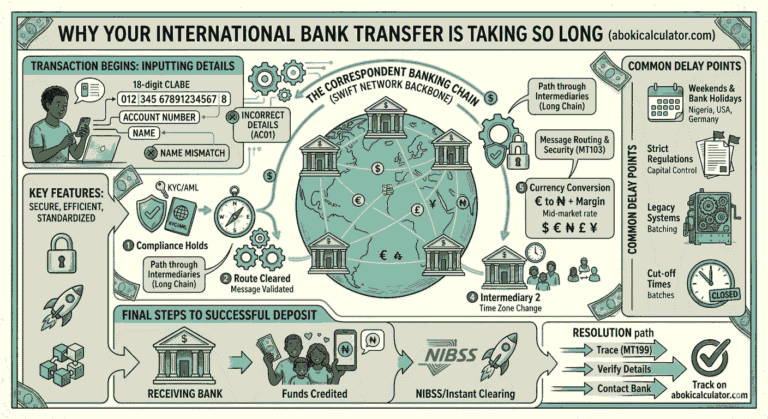
The cross-border leg is usually fast. Swift's data show that 90% of payments reach the beneficiary's bank in under an hour. The wait is often at the end, in the step from the receiving bank to your account. Swift estimates that this last domestic step can take around 80% of the total processing time.
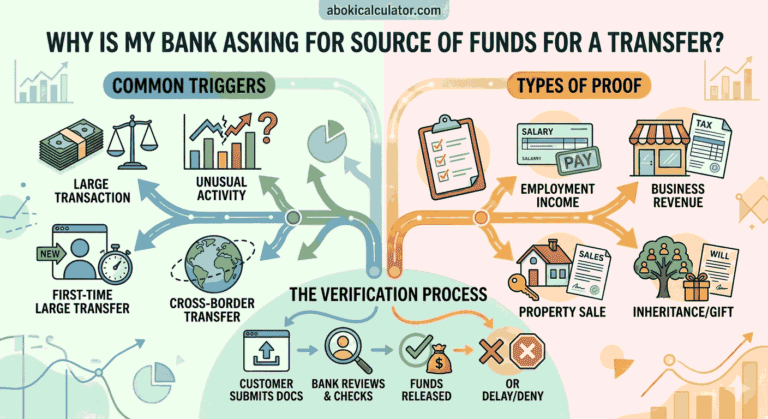
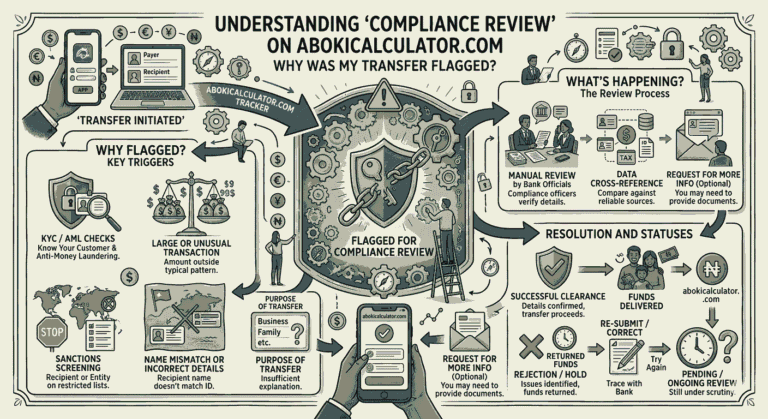
A receiving bank may hold a payment while it reviews it under anti-money laundering rules, or while it resolves details that do not match its records, such as a misspelt name or an account number with a missing digit. A payment that arrives after the bank's cut-off time, or on a non-working day, is usually processed the next business day. Our guides on why a transfer takes so long and on compliance reviews cover both.
Tracking a payment
Every payment instruction on the Swift network carries a code of 36 characters called the UETR, short for Unique End-to-end Transaction Reference. Intermediary banks must keep it unchanged, so it stays with the payment from the first bank to the last.
The sender can get the UETR from their bank. It is often printed on the detailed payment confirmation, which banks may call an MT103 copy. An MT103 shows that the sending bank issued the instruction. It does not show that the money has been credited to you. With the UETR, your bank can locate the incoming payment. Our SWIFT payment tracker helps you find the UETR and read its status.
A transfer through an operator has the operator's own reference. Its website or app is the first place to check.
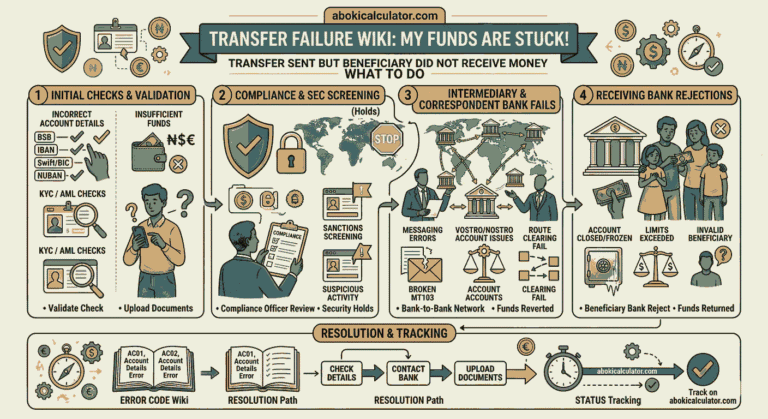
If the money has not arrived
- Ask the sender for four details: the UETR or the operator's reference, the exact amount and currency, the date it was sent, and the name of the sending bank or operator.
- Give those details to your bank in writing and keep a copy.
- Allow the bank two weeks to resolve the complaint. The CBN asks customers to complain to their bank first.
- If it is still unresolved, escalate to the CBN Consumer Protection Department, with evidence that you lodged the complaint with the bank first. Its email address is cpd@cbn.gov.ng.
Our guide on a transfer that was sent but not received goes through this in more detail.
What it costs the sender
Cost falls on the sender, but it changes how much reaches you. The World Bank tracks provider prices in its Remittance Prices Worldwide database. In the third quarter of 2025, sending $200 from the United States to Nigeria cost 2.72% on average, and sending £120 from the United Kingdom cost 1.96%. The global average was 6.36%. Prices change every quarter, so check the current figures before you rely on these.
The sender can compare offers with our Remittance Calculator, which shows what each provider charges and what you would receive.
Stay safe
A sender never needs your PIN, card details, online banking password or one-time codes to send you money. Share only your name, account number, bank name and the bank's SWIFT/BIC. If a message asks you to pay a fee to release money that is waiting for you, check with your bank before you pay anything. Bank details sent by email or chat are a common route for payment fraud, so confirm any change in details by a second channel.
Related questions
What does a sender need to send money to my Nigerian bank account?
Your full name as it appears on the account, your 10-digit NUBAN, your bank's name and its SWIFT/BIC code. Some senders and banks also ask for the bank's address. If your bank publishes payment instructions that name an intermediary bank, give those exactly.
Can I receive dollars in Nigeria?
A bank transfer in foreign currency can be credited to a domiciliary account. Licensed money transfer operators pay recipients in naira only. Ask your bank whether your account can receive foreign currency and which details to give the sender.
What is the cash limit on money sent through an operator?
The maximum cash payout is the naira equivalent of $200. Any amount above that must be paid into a bank account. Press reports of the CBN's 2026 Foreign Exchange Manual and the 2024 operator guidelines both describe this limit.
Do I need a domiciliary account to receive money from abroad?
Not for naira. You need one if you want a foreign currency transfer credited as foreign currency. Ask your bank whether a naira account can receive a foreign currency payment, and at what rate it would be converted.
How long does a transfer from abroad take?
Swift's data show 90% of payments reach the recipient's bank in under an hour. The last step, from your bank to your account, often takes longer. Compliance reviews, mismatched details, cut-off times and non-working days can add a business day or more.
What is a UETR?
A 36-character code that identifies one payment on the Swift network and stays with it from the first bank to the last. The sender's bank can give it to the sender, and your bank can use it to find the payment.
Who do I complain to if the money does not arrive?
Your bank first, in writing. The CBN asks customers to allow two weeks. If the bank has not resolved it, you can escalate to the CBN Consumer Protection Department with evidence of the first complaint.
Keep going
Sources
- The Guardian Nigeria, Receiving money from abroad in Nigeria: What CBN's 2026 remittance rules change (23 October 2026): the two routes, the 31 January 2024 operator guidelines, the 24 March 2026 circular and its 1 May 2026 start, the UETR and MT103 explanation, the Swift estimate that the final domestic step takes around 80% of processing time, and the complaint steps.
- TheCable, $10k for cross-border movement, hefty fines: 7 things to know about CBN's new FX manual (3 June 2026): the manual's wording on inbound transfers and the $200 cash limit.
- Central Bank of Nigeria circulars TED/FEM/FPC/GEN/001/002 (31 January 2024) and TED/FEM/FPC/PUB/001/002 (24 March 2026), through the CBN circulars index.
- Central Bank of Nigeria, Consumer complaints: complain to the bank first, allow two weeks, then escalate to the Consumer Protection Department.
- Swift, Who we are, and Swift data of 17 October 2024: 90% of payments reach the beneficiary bank in under an hour.
- World Bank, Remittance Prices Worldwide, third quarter 2025: the United States to Nigeria and United Kingdom to Nigeria averages and the global average.
This guide explains how money from abroad reaches Nigerian accounts in general terms. It is not financial or legal advice. Rules change, and banks and operators apply their own checks, so confirm the details with your bank or operator before you rely on them.