Guides · Nigeria Payments
The CBN raised the tuition remittance limit to $25,000 per semester in 2026. This page shows what the limit covers, how living costs are treated, and what to prepare before you ask your bank.
Short answer
Under the CBN's 2026 Foreign Exchange Manual, you can remit up to $25,000 per semester for tuition at an eligible overseas higher education institution. The old limit was $15,000. The payment goes through an authorised dealer bank, and when tuition and living costs are billed together the money is sent directly to the school.
Living costs billed separately, or for a student living off campus, can be remitted up to $5,000 per quarter. Nursery, primary, secondary, foundation and A-Level programmes are not covered. The limits came into effect on 1 June 2026.
On this page
What the limits cover
| Limit | How it is paid | |
|---|---|---|
| Tuition, undergraduate and postgraduate | $25,000 per semester | To the institution, through an authorised dealer bank |
| Tuition and maintenance billed together | Ask your bank how the combined bill counts against the limits | Directly to the institution |
| Maintenance billed separately, or off campus | $5,000 per quarter | Remitted separately |
| Nursery, primary, secondary, foundation, A-Level | Not covered | Not available under these limits |
The cap rose from $15,000. Education consultants told The PIE News that many international tuition fees now exceed the old figure, particularly in the UK, US, Canada and Australia. They also said the limit is one part of the process, next to visas and funding.
The CBN gave the 2026 manual to authorised dealer banks and did not publish the text, so the figures here come from press reports and law-firm summaries. Ask your bank how it applies them.
Steps to pay
- Get the invoice from the school. It should show the student, the programme, the semester and the amount, and the school's bank details.
- Tell your bank early which institution you are paying and for which semester. Ask which documents it needs. One bank's trade pages name school fees among the service payments covered by Form A, so ask whether it applies to you.
- Check the payee details. Use our bank details tool to see what a payment to the school's country needs, such as an IBAN or a sort code.
- Compare the exchange rate before you instruct the bank. Ask for the rate in writing.
- Keep the payment confirmation, and ask your bank for the UETR so you can track it.
Paying from a domiciliary account
If you already hold foreign currency in a self-funded domiciliary account, the 2026 manual treats an outward payment as an instruction to your bank. Press and law-firm summaries say a dom account holder can start telegraphic transfers of up to $10,000 a day without the full trade documentation. Above that, or where the payment has a purpose that needs documents, the bank asks for supporting paperwork.
A bank that processes a foreign exchange payment without adequate documents can be fined, so expect it to ask what the payment is for. A school invoice answers that question. Our guide to the domiciliary account covers how these accounts work.
What the payment costs
The limit decides how much you may send. The exchange rate and fees decide what it costs. A margin of a few percent on a $10,000 payment is a few hundred dollars. Our guide to what international transfers cost shows typical prices, and how FX spreads work shows how to measure the margin in your bank's quote. The Remittance Calculator compares offers side by side.
Proving the school received it
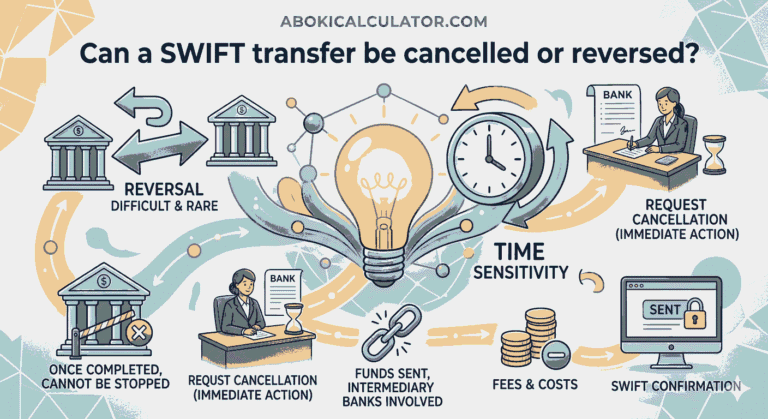
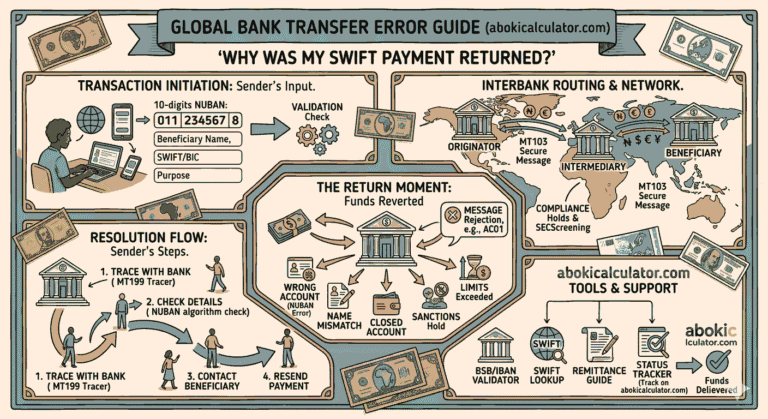
Ask your bank for the payment confirmation and the UETR, the 36-character code that follows a payment across the Swift network. The school's finance office can match the payment to the student with that code and the invoice number. If the school says it has not received the money, our SWIFT payment tracker helps you find the UETR and read its status, and the guide on a transfer that was sent but not received lists what to do next.
Related questions
How much can I send for tuition per semester?
Up to $25,000 per semester under the CBN's 2026 Foreign Exchange Manual, up from $15,000. The limits came into effect on 1 June 2026 and apply to payments through authorised dealer banks.
Does the limit cover primary or secondary school fees?
No. Nursery, primary, secondary, foundation and A-Level programmes are excluded. The limit covers undergraduate and postgraduate programmes at eligible overseas higher education institutions.
Who is the money paid to?
To the educational institution. When tuition and maintenance are billed together, the remittance is sent directly to the school and not to the student.
What about living costs?
Students living off campus, or whose maintenance is billed separately, can receive up to $5,000 per quarter. Tuition and maintenance are treated as separate items.
Can I pay a university from my domiciliary account?
Press and law-firm summaries say a dom account holder can start telegraphic transfers of up to $10,000 a day without the full trade documentation. For larger or documented payments your bank will ask for supporting paperwork, so ask it first.
Do I still need Form A?
Summaries of the 2026 manual say Form A was removed for outward transfers from a self-funded domiciliary account. One bank's trade pages list school fees among the service payments Form A covers when you buy foreign currency from the bank, so ask which applies to you.
Keep going
Sources
- The PIE News, Nigeria lifts tuition remittance cap even as visa concerns persist (15 June 2026): the increase from $15,000 to $25,000, the 1 June 2026 start, direct payment to the institution, the $5,000 quarterly maintenance limit and the excluded programmes.
- TheCable, $10k for cross-border movement, hefty fines: 7 things to know about CBN's new FX manual (3 June 2026): the $25,000 per semester tuition limit, its payment to the institution and the $10,000 daily dom account transfer limit.
- Daya, Do you still need Form A and Form M in Nigeria? (8 October 2026), which summarises law-firm readings of the manual and one bank's trade pages: Form A's coverage of school fees, its removal for self-funded dom account transfers, and the documentation duty on banks.
- Central Bank of Nigeria, Reforms and Initiatives: the launch of the fourth edition of the Foreign Exchange Manual in May 2026.
This guide explains school fee remittances in general terms. It is not financial or legal advice. The CBN can change its limits, and banks apply their own procedures, so confirm the details with your bank before you pay.