Guides · Bank Codes & Payment Identifiers
Bank Code vs SWIFT Code: What's the Difference, and Which Do You Need?
One gets money around inside a country. The other gets it across borders. Give the wrong one and a payment can be delayed or bounced back.
Quick answer
A bank code is a domestic code that identifies a bank, and sometimes a branch, inside one country's payment system. It has a different name and format in each country: a routing number in the US, a sort code in the UK, an IFSC in India, a BSB in Australia.
A SWIFT code (also called a BIC) is an international code, 8 or 11 characters long, that identifies a bank in payments between countries. The format is the same everywhere.
Rule of thumb: paying someone in the same country? You may need their bank code. Sending money abroad by bank transfer? You need the SWIFT code. Some countries ask for both. Neither code identifies the account, so you always need the account number (or IBAN) as well.
On this page
Bank code vs SWIFT code at a glance
| Bank code | SWIFT code (BIC) | |
|---|---|---|
| Used for | Payments inside one country | Payments between countries |
| Identifies | A bank, and in many countries a branch | A bank or institution, and optionally a branch or unit |
| Format | Different in every country, usually digits (e.g. 6, 8 or 9 digits) | Always 8 or 11 letters and digits |
| Set by | Each country's banking or payment authorities | One international standard, ISO 9362, issued by Swift |
| Local names | Routing number, sort code, IFSC, BSB, BLZ, transit number… | SWIFT code, BIC, SWIFT/BIC |
| Identifies the account? | No (except where it is built into the account number, such as Mexico's CLABE) | No |
What is a SWIFT code?
A SWIFT code is the everyday name for a BIC, or Business Identifier Code. It is defined by the international standard ISO 9362, and Swift, the network banks use to send each other payment messages, is the official body that issues the codes. In an international bank transfer, the SWIFT code tells the banks along the way which institution the money is going to.
Every SWIFT code has the same structure. Here it is on a real example, DEUTDEFFXXX (Deutsche Bank's head office in Frankfurt):
DEUTInstitutionDECountryFFLocationXXXBranch (optional)- Characters 1–4, the institution. The official name is the "business party prefix". Older guides call it the "bank code", which is one reason people mix the two terms up.
- Characters 5–6, the country: the two-letter ISO country code, such as
NGfor Nigeria orGBfor the UK. - Characters 7–8, the location (officially the "business party suffix").
- Characters 9–11, the branch, which is optional.
XXX, or leaving it out, usually means the main office.
Not every institution with a BIC can send messages over Swift. Swift issues both connected BICs, which can use the network, and non-connected BICs, which are used for reference only.
What is a bank code?
"Bank code" is a general term, not one code. Each country that needs one designs its own, for its own payment systems. Some identify just the bank, some identify the branch, and some are built into the account number itself. Here are the ones we have checked against official sources:
| Country | Local name | Format | Check it |
|---|---|---|---|
| United States | ABA routing number | 9 digits | Checker |
| United Kingdom | Sort code | 6 digits | Validator |
| Ireland | National Sort Code (NSC) | 6 digits | Checker |
| Canada | Transit and institution numbers | 5 + 3 digits | Checker |
| Australia | BSB | 6 digits | Checker |
| India | IFSC | 11 characters | Checker |
| Germany | BLZ (Bankleitzahl) | 8 digits | Checker |
| Mexico | CLABE (account number with bank code built in) | 18 digits | Checker |
| South Africa | Branch code | 6 digits | Lookup |
| Japan | Zengin code | 4-digit bank + 3-digit branch | Finder |
| China | CNAPS code | 12 digits | Lookup |
| Philippines | BRSTN | 9 digits | Lookup |
| Nigeria | CBN bank code, used in the 10-digit NUBAN | 3 digits | NUBAN validator |
Some countries' fast-payment systems need no bank code at all. The account number or a phone-linked alias is enough. Our What Bank Details Do I Need? tool covers the full list.
The trap: three different things people call a "bank code"
When a form or a sender asks for your "bank code", find out which of these they mean before you answer:
- 1. Your country's domestic bank or branch codeSuch as a US routing number or a UK sort code. This is the most common meaning, and the one this guide compares with SWIFT.
- 2. The first four characters of a SWIFT codeOlder guides and some forms call the institution part of a BIC (
DEUTinDEUTDEFF) the "bank code". If a field is exactly four letters long, this is probably what it wants. - 3. A bank's USSD or app shortcodeIn Nigeria, a bank's USSD code (such as
*966#for Zenith Bank) is sometimes loosely called its "bank code". It is for mobile banking on your phone and is never used to route a payment. See our Nigerian bank USSD codes.
Which code do you need? By country
What the sender needs to pay a bank account in each country. "Sometimes" means some banks or senders ask for it.
| Recipient's bank is in… | Paying from the same country | Paying from abroad |
|---|---|---|
| Nigeria | Account number (NUBAN) + bank name | SWIFT code + account number + bank name |
| United States | ABA routing number + account number | SWIFT code + account number; routing number sometimes |
| United Kingdom | Sort code + account number | IBAN + SWIFT code (IBAN only from within SEPA) |
| India | IFSC + account number | SWIFT code + account number; IFSC sometimes |
| Canada | Transit and institution numbers + account number | SWIFT code + account number; transit and institution numbers sometimes |
| Australia | BSB + account number | SWIFT code + account number; BSB sometimes |
| Germany | IBAN (the BLZ is inside it) | IBAN + SWIFT code (IBAN only from within SEPA) |
Always add the account holder's full name as it appears on the account and the bank's name. For any other country, use What Bank Details Do I Need?
For Nigerian users
Nigerian banks have several codes, which is why "bank code" causes so much confusion here:
- The 3-digit CBN bank code, such as
057for Zenith Bank. The Central Bank of Nigeria's NUBAN standard uses it, together with the first nine digits of your account number, to calculate the account number's last digit (the check digit). Your bank app fills it in when you choose the recipient's bank, so you rarely type it yourself. - A 6-digit institution code used for interbank transfers, such as
000013for GTBank. It is a different number from the 3-digit code. - The SWIFT code, which you need to receive money from abroad by bank transfer. A Nigerian SWIFT code has
NGin characters 5 and 6.
Receiving money from abroad into a Nigerian account? Give the sender your full name as it appears on the account, your 10-digit account number, your bank's name and your bank's SWIFT code, plus the bank's address if they ask. You don't need to give the 3-digit or 6-digit code. If a form asks for a "sort code" for a Nigerian bank, ask your bank which code it means. Money sent through a money transfer company is paid out in naira, usually needs only local details, and follows different rules.
Not all Nigerian institutions have a SWIFT code of their own. If yours doesn't, ask it how to receive international payments.
How to find and check a code
- Ask the bank, or look in your banking app or on a statement. Many banks list their SWIFT code on their website's international transfers page. This is the most reliable source.
- Check the format. Our SWIFT code checker tests the length, the characters and the country code, and looks the code up in a published list of registered institutions. The country checkers in the table above do the same for national codes.
- Match the code to the right bank and branch. Some banks use the main-office SWIFT code for all international payments, while others use branch codes. If in doubt, use the code the bank gives you.
- Confirm the account with the recipient. A code that is valid in format can still belong to a different bank than you think, and it never proves who owns the account.
Not sure which details to ask for?
Choose send or receive, local or international, and the country. The tool lists exactly which details to give or ask for, including the SWIFT/BIC code, IBAN and any local bank code, with links to the right checker.
Open What Bank Details Do I Need?Common mistakes
- Putting a domestic code in the SWIFT field. A 6- or 9-digit number is never a SWIFT code. SWIFT codes always contain letters, and characters 5–6 are always a country code.
- Using the SWIFT code of the wrong bank. Many banks have similar names, and a bank's parent company or partner abroad has a different code.
- Thinking the code identifies the person. Neither a bank code nor a SWIFT code identifies the account. The account number and name do.
- Confusing a USSD code with a bank code.
*737#-style codes are for phone banking only. - Copying a code from an unofficial list without checking it. Codes change when banks merge or restructure. Check with the bank.
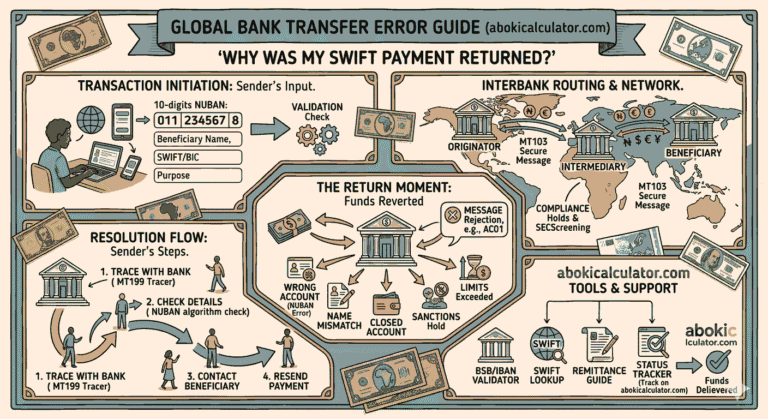
A wrong code can get a payment held, returned or, rarely, credited to the wrong place. See why Swift payments are returned.
Related questions
Is a SWIFT code the same as a bank code?
No. A bank code is a domestic code, such as a US routing number or a UK sort code, that identifies a bank or branch inside one country. A SWIFT code, or BIC, is an international code of 8 or 11 characters used for payments between countries. Some older guides call the first four characters of a SWIFT code the "bank code", so check which one a form is asking for.
Is a sort code the same as a SWIFT code?
No. A UK sort code is 6 digits and identifies a bank branch for payments within the UK. A SWIFT code is 8 or 11 letters and digits and is used for international payments. To receive money in the UK from abroad you usually give your IBAN and your bank's SWIFT code, not the sort code.
What is my bank code in Nigeria?
It depends on who is asking. Inside Nigeria, banks have a 3-digit CBN bank code, such as 057 for Zenith Bank, which the NUBAN standard uses to calculate your account number's check digit, and a separate 6-digit institution code for interbank transfers. For money from abroad, what the sender needs is your bank's SWIFT code, not either of these.
Do I need a SWIFT code to receive money from abroad in Nigeria?
For a bank-to-bank international transfer, yes. Give the sender your full name as it appears on the account, your 10-digit account number, your bank's name and its SWIFT code. Money transfer companies that pay out in Nigeria usually ask only for local details, such as the account number and bank name.
Does every bank have a SWIFT code?
No. Swift issues a BIC to institutions that register for one, and some BICs are not connected to the Swift network at all. Smaller banks and some newer financial institutions may not have their own. If yours doesn't, ask it how it receives international payments.
Does a SWIFT code identify my account?
No. A SWIFT code identifies the bank, and sometimes a branch, but never an individual account. The sender also needs your account number or IBAN and your name as it appears on the account.
What happens if I use the wrong code?
The payment may be rejected, held for checks or returned, usually minus fees, and in rare cases it may reach the wrong bank. Always take codes from the bank itself, and check the format before you send.
Keep going
Sources
- Swift, Business Identifier Code (BIC): ISO 9362 structure (business party prefix, country code, business party suffix, optional branch identifier); connected and non-connected BICs. Checked 24 September 2026.
- ISO, ISO 9362 Business identifier code (BIC).
- Central Bank of Nigeria, Proposals on the implementation of NUBAN (3-digit bank codes and the check-digit method), as applied in our NUBAN validator.
- National code formats: the official sources cited on each linked country checker, summarised on What Bank Details Do I Need?
This guide explains bank identifiers in general. It is not financial advice. Banks change codes and requirements, so confirm the details with the bank or the person you are paying before you send money.